








-
- show all
-
Trending Now
- Nootropics Nootropics
-
- show all
-
Trending Now
- Cosmetics Cosmetics
-
- show all
-
Trending Now
- New New
- UNBREAKABLE UNBREAKABLE
- Accessories Accessories
- Research Reagents Research Reagents
-
- show all
-
Peptides
- show all
-
Type
- show all
- 5-amino 1MQ
- ACTH 1-39
- Adamax
- Alarelin
- AOD-9604
- ARA 290
- ARG-BPC
- B7-33
- BPC 157
- Show more
- Bronchogen
- Cardiogen
- CJC DAC
- CJC-1295
- Cortagen
- DSIP
- Epithalon
- GC-1 SOBETIROME
- GHK-Cu
- GHRP-2
- GHRP-6
- GLP-1
- GRF
- HGH
- HGH fragment 176-191
- IGF DES
- IGF-1 LR3
- Ipamorelin
- Kisspeptin
- KPV
- L21
- Larazotide acetate
- Lipotropin
- Livagen
- LL-37
- Matrixyl
- Melanotan
- Melanotan 2
- Mots
- N-acetyl
- Oxytocin
- P-21
- Pancragen
- PEG-MGF
- Prostamax
- PT-141
- Retatrutide
- Selank
- Semax
- Sermorelin
- SLU-PP-332
- Snap 8
- TB-4 FRAG+BPC-157 ARG
- TB-500
- Thrombin peptide Tp508
- Thymalin
- Thymogen Alpha-1
- Thymosin
- Thymosin Alpha 1
- TRH
- VIP
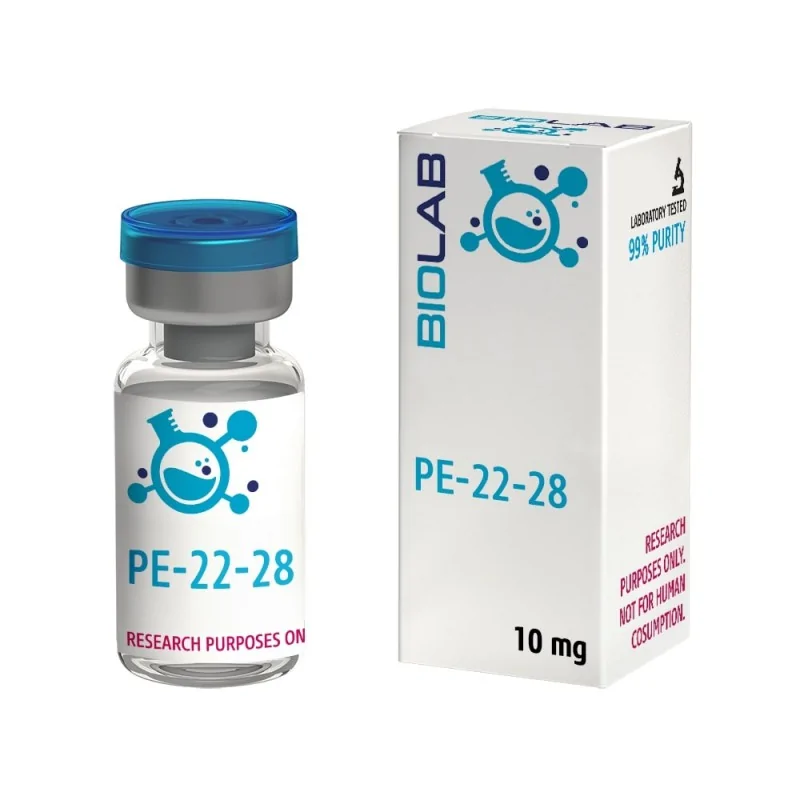
PE-22-28 10 mg
€42.64Tax includedNext day shippingSecure returns up to 30 daysProduct code:
Add to favorites
FOR RESEARCH PURPOSES ONLY
This product is not a drug or food and should be handled by qualified professionals in laboratory conditions. All product information is provided for educational purposes only.
INFORMATION:
- The product (substance) is not a food or dietary supplement, and is not suitable for human consumption.
- Keep out of the reach of children.
- Keep the container tightly closed.
- Store in a dry, cool, shaded place; protect from moisture.
- Store only in original container.
- Avoid contact during pregnancy and lactation.
- Consult a physician if you feel unwell or have adverse reactions related to contact with the substance.
PE-22-28 is a peptide under investigation in the area of neuromodulation. Among other things, it is described in the experimental literature in the context of its effects on K2P-type potassium channels (TREK-1) - structures associated with the regulation of neuronal excitability and signaling in the central nervous system. For this reason, PE-22-28 appears in studies involving models related to mood, stress, neuronal plasticity and cognitive function.
In preclinical work, PE-22-28 is also sometimes analyzed in the context of models of nervous system damage and overload (e.g., ischemic or neurodegenerative models) - as a tool for assessing effects on selected cellular markers and pathways, including those related to repair processes and neuronal homeostasis.
In addition, PE-22-28 is described as a peptide with antimicrobial activity under laboratory conditions. In vitro studies analyze its interactions with microbial cell membranes, as well as its potential in models including bacteria and fungi, and selected markers of the inflammatory response. The evaluation of PE-22-28 on cell lines in the context of programmed cell death processes (in vitro studies) also appears in part of the publication.
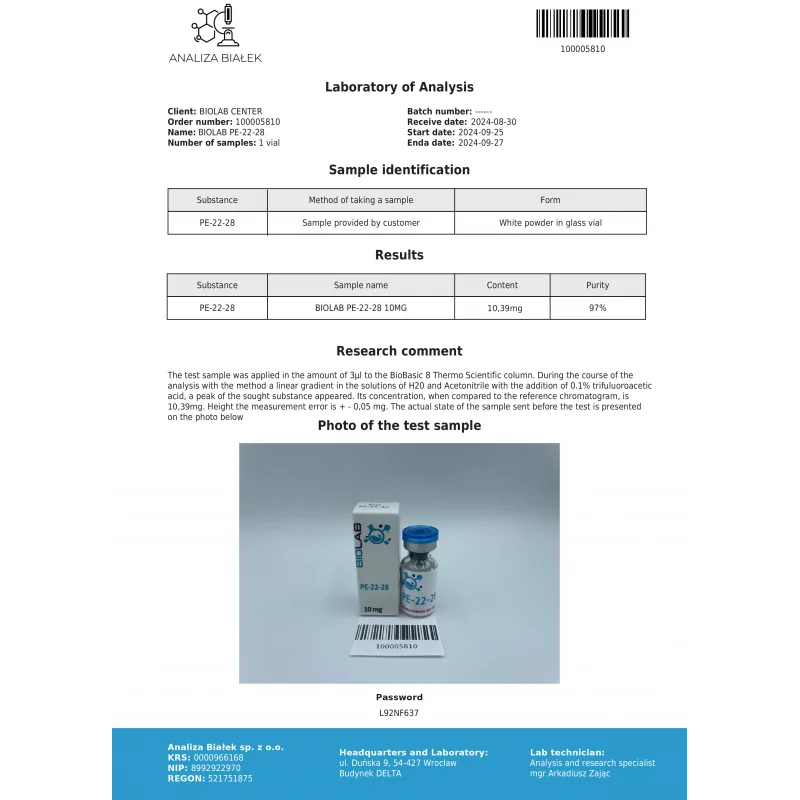
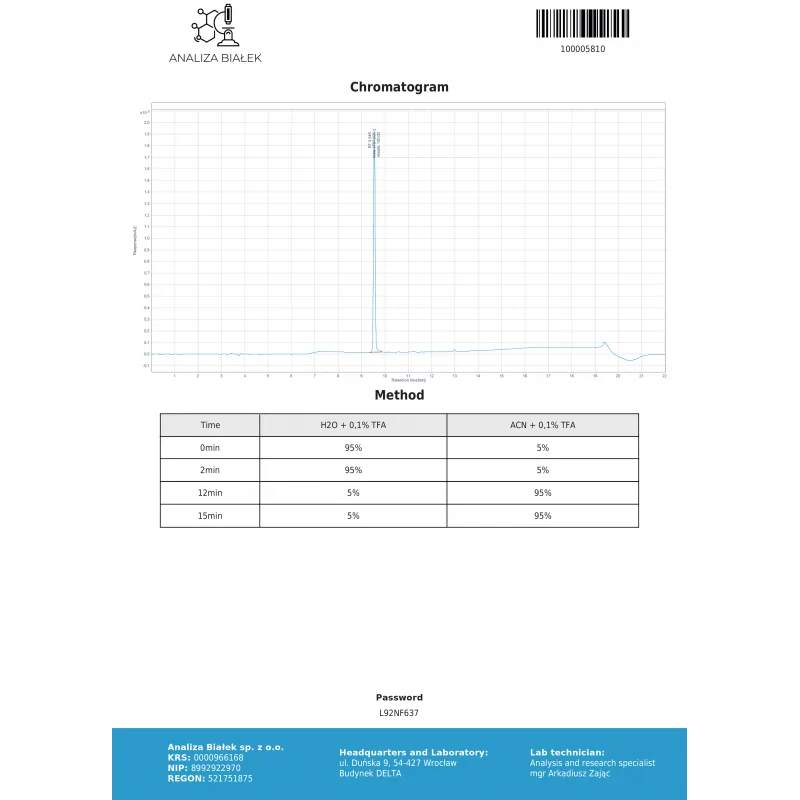
BIOLAB PE-22-28 10 MG with laboratory-confirmed peptide content — the test showed 10.39 mg per vial, which with HPLC analysis and an error of ±0.05 mg confirms conformity with the manufacturer's declaration.
561 Items - Cosmetics Cosmetics
- Nootropics Nootropics
Your review appreciation cannot be sent
Report comment
Report sent
Your report cannot be sent
Write your review
Review sent
Your review cannot be sent
Customers who bought this product also bought:
Vitamin K2 MK-7 100 mcg, 60 caps
GHK-Cu copper peptide 20 mg
BPC-157 10 mg
Andarine S4 25 mg, 60 caps
Burn From The Hell 275.5 mg
Melatonin 1 mg, 60 caps
ACTH 1-39 5 mg
Bisglycinate magnesium 700 mg, 60 caps
Blog
Newsletter
Get a discount on your first order
Expert in supplementation and innovative health, fitness, and beauty solutions.
Category
Offer
Our company
E-mail address
info@biolabshop.euE-mail address
office@biolabdxb.comWhatsApp
+44 739 8562 456Phone
+97 154 7401 919